
Balancing Education in a Busy Modern Life
Balancing education with a career and personal life can feel difficult, especially when you already have a full-time job and several responsibilities. You may want to continue studying to improve your qualifications, develop new skills or prepare for a better career opportunity. At the same time, you still have work deadlines, family responsibilities, social commitments and your own personal goals to think about.
So, how do you manage everything without constantly feeling overwhelmed? The answer is not necessarily about finding more hours in the day. It is about using the time you already have more effectively and choosing an education format that works with your lifestyle.
For working professionals, flexible learning options can make it possible to continue studying without putting a career on hold.
Here are 7 practical ways to balance education, work and everyday life.
1. Understand Why You Want to Continue Your Education
Before enrolling in a course or degree, take some time to understand what you actually want from it.
Ask yourself: What am I hoping this qualification will help me achieve?
Perhaps you want to qualify for a management position. Maybe you are considering a career change. You may want to develop skills related to your current industry or simply want to expand your knowledge. Having a clear reason behind your decision can make balancing education and career much easier.
When your schedule becomes difficult, remembering the reason you started can help you stay motivated. Instead of seeing studying as another task you have to complete, you start seeing it as an investment in your future.
2. Choose an Education Format That Fits Your Career
Not every learning format will suit every professional.
A traditional classroom-based program may work well for someone with a flexible schedule. But if you work full-time, travel frequently or have significant personal responsibilities, attending classes at fixed times may be difficult. This is where online degrees for working professionals can provide greater flexibility.
LearnEdge offers fully online programs specifically designed around the needs of working professionals in the UAE, with programs across bachelor’s, master’s, doctorate and diploma levels. (LearnEdge) You can explore LearnEdge’s online degree programs to compare different study options and find a program that aligns with your career goals.
However, flexibility should not be the only factor you consider.
Before choosing a program, research the institution, academic partner, qualification, curriculum, duration and applicable recognition or accreditation.
The goal is not simply to find an online course. It is to find an education option that fits both your schedule and your career goals.
3. Create a Realistic Weekly Schedule
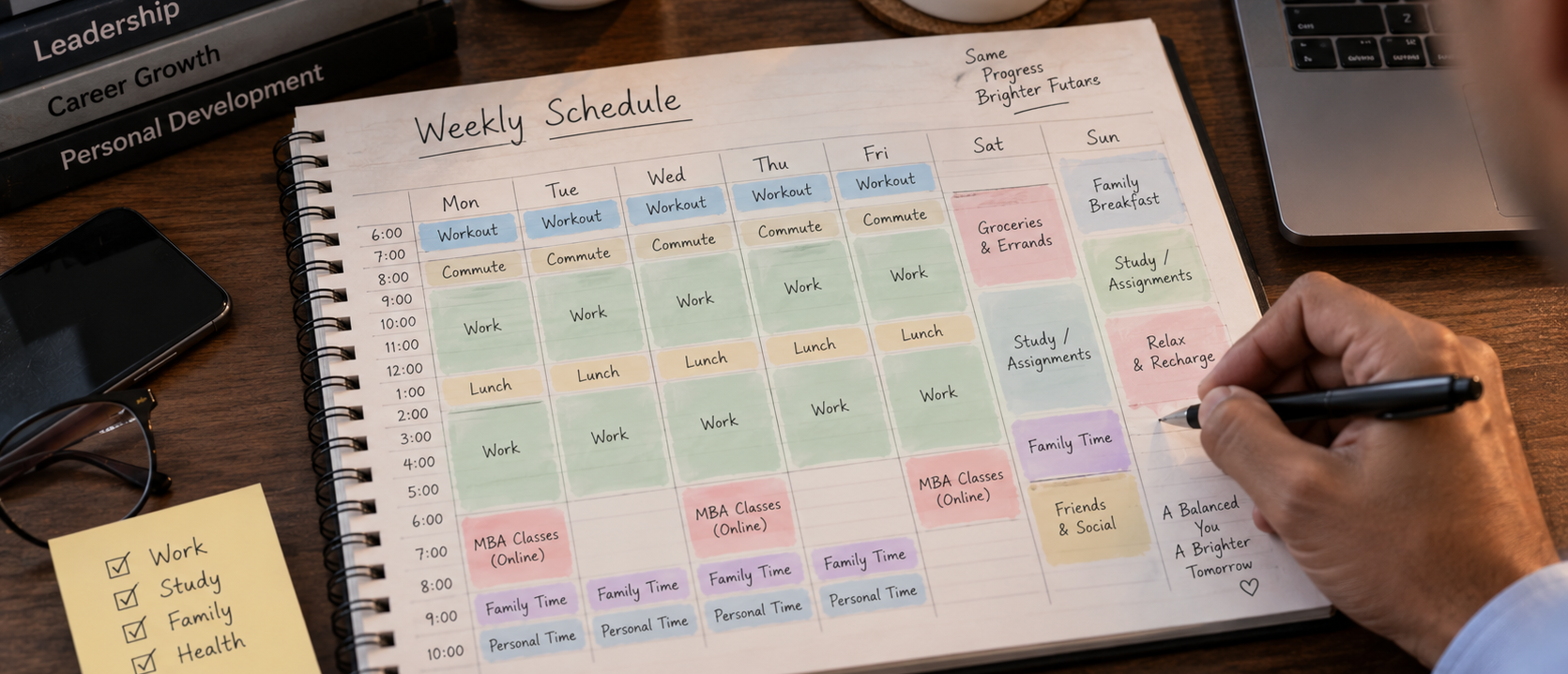
One of the simplest ways to improve balancing education and career is to create a weekly schedule. Start by looking at your entire week.
Include:
- Working hours
- Commute time
- Study sessions
- Assignment deadlines
- Family responsibilities
- Exercise
- Personal time
- Social commitments
- Sleep
Once everything is written down, look for realistic periods when you can study. You might decide to study for one hour after work three days a week and dedicate a few hours during the weekend to assignments.
You do not necessarily need to study for several hours every day. Consistency is often more useful than trying to do everything at once. A realistic schedule that you can maintain is better than an ambitious schedule that you abandon after two weeks.
4. Learn to Prioritise Your Responsibilities
When you are working and studying at the same time, everything can start feeling urgent. That is why prioritisation matters.
Try dividing your responsibilities into three categories:
Urgent
These are tasks that require immediate attention, such as work deadlines, examinations or assignments due soon.
Important
These are activities that contribute to your long-term goals, such as completing coursework, developing professional skills or preparing for an upcoming career opportunity.
Optional
These are activities that are useful or enjoyable but can be postponed when your schedule becomes particularly busy.
This approach can help you focus on what actually needs your attention instead of trying to complete everything simultaneously.
5. Don’t Forget About Your Personal Life
When professionals decide to pursue another qualification, it can be tempting to dedicate every free moment to work and education.
That approach may work temporarily, but it is difficult to maintain over the long term. A healthy work life balance for students does not mean spending exactly the same amount of time on work, education and personal activities every day.
It means making space for the things that keep you healthy, focused and motivated.
Spend time with your family.
Take breaks.
Get enough sleep.
Exercise.
Make time for things you enjoy.
Your personal life should not completely disappear simply because you have decided to continue your education. In fact, taking regular breaks can make it easier to return to your studies with better concentration.
6. Use Technology to Make Learning More Manageable
Technology can make balancing education considerably easier when used properly.
Digital calendars can help you keep track of important deadlines. Reminders can help you stay on top of assignments. Cloud storage can keep your study materials organised and accessible. Online learning platforms can also give working professionals greater flexibility because learning materials can be accessed remotely.
This is one reason online education in the UAE can be useful for professionals managing demanding careers. LearnEdge’s programs are delivered online and are designed around the schedules of working professionals. (LearnEdge)
You can also review the LearnEdge FAQs to understand more about studying online while working full-time. However, technology can also become a distraction.
If you are studying online, try creating a dedicated study period where you avoid unnecessary notifications, social media and unrelated emails.
The objective is to use technology to save time, not consume more of it.
7. Give Yourself Time to Adjust
You should not expect to immediately become perfect at managing work, education and your personal life.
Some weeks will be easier than others. There may be periods when work becomes extremely busy. An assignment may take longer than expected. Personal responsibilities may suddenly require more of your attention.
That does not mean your plan has failed. Instead of giving up, adjust your schedule.
If you cannot complete a planned study session one evening, find another suitable time. If an especially busy week affects your study routine, reorganise the following week. Balancing education is a long-term process, not something you master overnight.
What matters is continuing to make progress.
How Can Online Education Help Working Professionals?
For professionals who want to continue learning without leaving their careers, flexible education can provide a practical solution.
Online programs allow professionals to pursue further education while continuing to work. This can be particularly useful for people who cannot commit to attending a traditional campus every day.
LearnEdge provides online education options through international academic partners across areas such as business, management, technology, healthcare and other professional fields. Its current program portfolio includes bachelor’s, master’s, doctorate and diploma-level options. (LearnEdge)
If you are unsure which qualification fits your goals, you can also learn more about LearnEdge’s academic partners before making a decision.
When considering a program, professionals should look beyond flexibility and examine:
- Who awards the qualification
- The academic institution or partner
- Program structure
- Duration
- Admission requirements
- Applicable recognition or accreditation
- How the program fits their career goals
Why Does Accreditation Matter?
Flexibility is important, but it should not be the only consideration when choosing an online degree. You should understand exactly who awards the qualification and what recognition or accreditation applies to it.
The UAE’s Commission for Academic Accreditation (CAA) is the federal quality assurance agency for higher education. It handles institutional licensure and accreditation of award-bearing academic programs in the UAE. (CAA) The CAA also provides an Accredited Programs directory where users can search programs by institution, emirate, subject area, study level and program status. (CAA)
Before enrolling in any program, therefore, take the time to understand the institution, awarding body and recognition requirements relevant to your specific goals.
This is especially important if you intend to use your qualification for employment, further education or professional purposes.
Can You Study While Working Full-Time?
Yes, but balancing education and career requires planning and discipline.
One of the biggest advantages of studying while working is that you do not necessarily have to choose between professional experience and further education. You can continue gaining experience in your industry while developing your academic knowledge.
Your professional experience can also make your studies more practical. Concepts you learn through your program may connect directly to situations you encounter at work. For example, a professional studying management may be able to apply leadership, communication or business concepts to their existing workplace.
This connection between education and professional experience can make learning more relevant.
What Is the Best Way to Balance Education and Life?
There is no single routine that works for everyone.
A young professional with a flexible job may have a very different schedule from someone managing a demanding career and family responsibilities. Instead of trying to copy someone else’s routine, create one based on your own circumstances.
Ask yourself:
- What are my biggest career goals?
- Why do I want to continue my education?
- How many hours can I realistically dedicate to studying?
- Which learning format works with my schedule?
- What personal responsibilities need to remain a priority?
- Which activities can I reduce or postpone?
- How will this qualification contribute to my long-term career?
Answering these questions can help you create a realistic plan rather than one based on an ideal version of your life.
The Goal Isn’t to Do Everything at Once
Balancing education does not mean trying to work, study, socialise and manage every responsibility perfectly every single day.
Sometimes your career will need more attention.
Sometimes your studies will take priority.
And sometimes you simply need to step away and focus on yourself.
The goal is to create a system that allows you to manage these different areas over time.
With flexible learning, proper planning and realistic expectations, continuing your education does not necessarily mean putting the rest of your life on hold.
Final Thoughts
Balancing education, career and personal life can be challenging, but it is possible with the right approach. Start by understanding why you want to study. Choose a program that fits your professional commitments, create a realistic schedule and learn to prioritise your responsibilities.
Most importantly, do not expect yourself to be perfect.
Education is a long-term investment. You do not need to complete everything immediately. You simply need to keep moving forward. For working professionals, flexible education can provide an opportunity to develop new knowledge and qualifications while continuing to build a career.
The right balance is not about having more time. It is about making better use of the time you already have.